

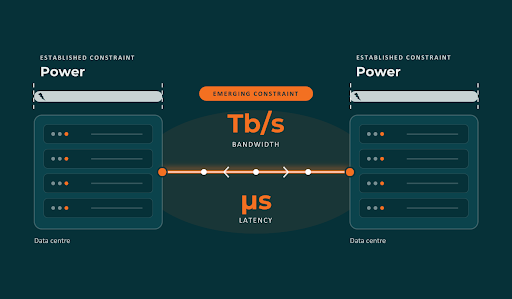
Power has long been the yardstick for data centres — kilowatts, megawatts and now gigawatts — as it is an effective proxy for compute infrastructure capacity. This metric has stood up well from the on-premise and cloud eras through to the modern AI landscape.
Nowadays, power also represents a fundamental data centre expansion constraint that must be navigated. According to Gartner [1], worldwide data centre power demand is expected to rise 27% by the end of 2026 to reach 132 gigawatts, and to grow to 290 gigawatts by 2030. Gartner also notes that grid supply will struggle to meet this ongoing demand.
Consequently, utility constraints are pushing new data centre buildouts to metropolitan edges, and increasingly, beyond traditional metro hub locations. Power supply remains a core limitation, but to meet the business demands of digital and AI workloads, the connectivity between more geographically dispersed data centres is becoming as critical as powering the facilities.
Bandwidth throughput requirements continue to increase. The growth of AI inferencing adds further pressures, as these workloads are typically less latency tolerant. Hence, terabit-per-second bandwidth and milli- and microsecond latencies are emerging as important technical requirements for organisations over time.
In her byline for Data Center Dynamics, our Chief Commercial Officer Geraldine Kor shares her expert views on how bandwidth, latency and resilience are important digital connectivity considerations in the AI era, and why metro dark fibre provides greater control over all three.
Full byline article: AI’s Next Infrastructure Constraint.
[1] Source: Gartner, Data Center Electricity Consumption to Grow in 2026, 10 June 2026