

The theme of this year’s annual Alibaba Cloud Apsara Conference was “Intelligence Goes Beyond” — Alibaba framed the opportunity around three conference tracks:
- Expanding Intelligence — AI models to bring intelligence into production through continuous iteration. Deep reasoning, multimodal and AI-coding advances are pushing models from capability breakthroughs toward autonomous evolution.
- Reinventing Computing — AI chips provide boundless compute power and AI keep applications running reliably and ready out of the box. Together they form Alibaba’s full-stack AI infrastructure bet. 100,000-card cluster stability, trillion-parameter Mixture of Experts (MoE) inference efficiency and agentic RL elastic scaling.
- Unlocking New Frontiers — Agents free people from execution work, and a company’s competitiveness increasingly depends on how many productive agents it has. Intelligence is no longer a concept but a genuine productive force — one that places entirely new demands on the data and connectivity foundation beneath it.
Infrastructure reconstruction: inside the data centre and beyond it
Alibaba’s phrase for what is happening to cloud computing and AI digital infrastructure is “infrastructure reconstruction”. As the users of compute shift from humans to agents, the stack is being rebuilt from the ground up — 100,000-card clusters that stay stable, trillion-parameter MoE models that infer efficiently, and agentic RL workloads that scale elastically. Alibaba’s Scalable Near-Packaged Optics (SNPO) Panjiu super-nodes are the scale-up expression of this, targeting the enormous east-west traffic generated by GPU-to-GPU exchange within a single facility.
Reconstructing the infrastructure for intelligence therefore means reconstructing the interconnections between data centres as much as the servers inside them.
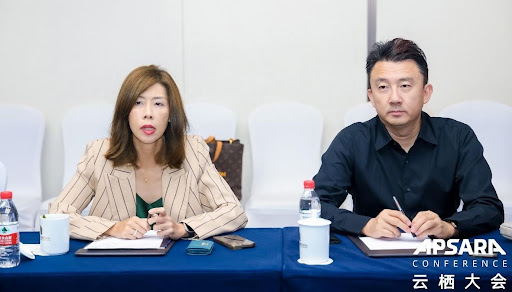
Xenith IG in Hangzhou
It’s not just Alibaba; other Chinese cloud and AI players are following their western counterparts in expanding their investments in digital infrastructure and AI solutions globally.
Members of Xenith IG’s leadership helped frame the discussions at the conference. As a trusted strategic vendor to global hyperscalers, social media platforms and super cloud operators, Chief Commercial Officer Geraldine Kor and Greater China General Manager Sammie Xi were well positioned to share their expert views on how the interconnection demands from AI workloads and workflows are evolving.
The bottom line
Metro dark fibre is a critical enabler of the infrastructure reconstruction required for AI at scale. Alibaba’s proposed buildout of 20GW of data centre capacity by 2032 will drive enormous volumes of latency-sensitive traffic — not only within individual data centres, where its SNPO vision optimises scale-up, but also between facilities, applications, agents and end-users. Xenith IG sits directly in that scale-across requirement: providing dedicated, high-capacity, low-latency metro dark fibre that gives hyperscalers control over their interconnection architecture, supports rapid capacity growth and prevents the network from becoming the bottleneck.